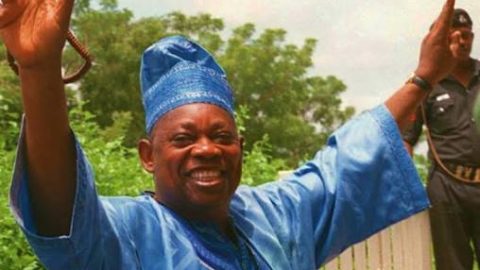
-By nyaknnoAbasi Osso
Before General Ibrahim Babangida left office, his administration appointed Senator Udoma Udo Udoma as the Chairman of the Corporate Affairs Commission (CAC). They wanted him to reform the CAC, which used to be a company registry. He was mandated to turn it around so that it could register companies and monitor them. Udoma studied law at Oxford University, and specialised in commercial law. That was the connection; CAC is a commercial institution.
I recall that Udoma came to my house in Lagos. He said there were several warehouses containing documentations from 1891 and that they were all scattered everywhere in Abuja. He believed that from my advertised expertise, exposure and experience, he could trust me to sort out the data for them. They took me from one warehouse to another. I saw rooms filled to the ceiling with files. I refused to be afraid. I went back home, and as I always did, I told myself this is a challenge you can overcome.
The first thing I did was to call my good friend, Richard Braithwaite Lloyd Fitzwilliams, Editor-in-Chief of the International WHO’S WHO, in London. I told him about the assignment I had, and asked how he could be of help to me. “I can only organise for you to go to the company house in Wales, in the UK,” Richard offered. He said they had an underground filing system. He concluded that if I went there, certainly, I would know what to do back in Nigeria.
Within seven days, I was there in the United Kingdom. From there, I went to understudy how things were done at the company house in London. From London I went to Wales. From there, I was linked to the company house at Albany, in the United States of America. I spent four weeks in Albany, studying how documents are processed in a computerised system. I was also exposed to the National Archives and Records Administration (NARA) on how they manage information for the office of the President of the United States of America. It was about analysis, documentation, finetuning information, storage and retrieval. Emphasis has always been on the fact that once you have the right quality of information, you can take the right decision. The next one is implementation.
By the time I returned to Nigeria, I had loads of information. That exposure in the United States and UK really helped me a lot. That was because I went to the source—I went to people who had done that kind of thing before and they put me through the processes. These were connections established and sustained over the years—since my days at the Nigerian Chronicle. They helped to solidify my background and knowledge about managing information, or managing knowledge. So, the establishment of the CAC in the manner that Udoma was mandated to do was partially made possible by the documents I brought from these countries. At that time, I was still committed to Newswatch, but as a consultant. I wasn’t going there frequently anymore.
Within that period, the late Senator Uche Chukwumerije was appointed Secretary of Information, an equivalent of Information Minister by the Ibrahim Babangida administration. As soon as they made the announcement, the first person he asked of was NyaknnoAbasi Osso. Somehow, I was not even aware that he was looking for me. So, why was he looking for me? It happened that, while I was on the CAC job for Senator Udoma, I was most of the time at the Transcorp Hilton Hotel. Usually, you would see me in the bookshop where they also sell magazines. One day, as I walked into the bookshop, I met Soji Akinrinade. We had worked together at Newswatch. He was surprised to see me there. “Aaahhh, it is God that has made me to see you today,” Akinrinade exclaimed. “There is one Minister that has been sending people to Newswatch to look for you for the past three months.”
He tried to recall the name of the Minister while we talked about other things. Eventually, he mentioned his name: Chukwumerije. It was about 3 p.m. Soji said he was in Abuja with other editors for a seminar. Even Ekpu and Dan Agbese were also there. He said the seminar would end by 3:30 pm. They had a chartered aircraft waiting for them at the Abuja airport for the return trip. He said the plane was almost empty and that I could fly with them back to Lagos so that I could meet with Chukwumerije. I quickly went back to where I used to stay with a friend, Dr Effiong Esu. I gathered a few belongings into my briefcase and went straight to the airport to join them.
As soon as we landed in Lagos, I took a taxi straight to Chukwumerije’s office at 15 Awolowo Road in Ikoyi. At the front desk, they told me that he was presiding over a meeting. I filled a form, which they took to him. The man left the meeting he was holding, and came to the door shouting, “Where is Osso? Where is Osso?” And I said, “Sir, see me here.” Once he saw me, he gushed, “This man, where have you been; I have been searching for you. Please come inside.”
As I followed him inside, he told those he was having the meeting with to go and come back later. As soon as we settled down, he turned to me and said he had been ordered by Ibrahim Babangida to do the kind of propaganda he did during the civil war on the side of Biafra. He said after a thorough scrutiny, he found out that only Nyaknno could organise the kind of information he needed, the same way he did for Newswatch.
“I want that kind of documentation,” he declared. We agreed that I should go and formally make a submission on the cost. What came to my mind was ten million naira. But after a proper analysis, it was increased to 22 million naira. That was the first contract I ever had in my life time. The minister gave approval immediately. I started work without further delay. I was given an office opposite the Voice of Nigeria Headquarters in Ikoyi. I gave him more than he anticipated. I programmed things in such a way that it was easy for him to do his propaganda work with ease.
Suddenly, one morning, he lost his job. I was yet to be paid in full. I was still being owed some money for the contract. A few days later, I went to the office and met the permanent secretary. I think he was one Dr Abori. After explaining my mission to the man, he said: “Aaah! Chukwumerije has left and there is no money in his account. The account was empty before he left.” I was thinking: What is this man talking about! I refused to be scared by him. I took my phone and called General Obasanjo who was in his farmhouse at Sango Ota, Ogun State.
At that time, those of us who worked with Baba were privileged to have the old school mobile telephone introduced in 1991 by Motorola. It was called Motorola Micro Tac Classic. Locally, we referred to it as Nought-NineNought—that is 090! That was what I used to call Baba that day.
I briefed him on what was happening. I told him I did a job for the Ministry of Information and I was being owed because the Minister had left. He asked me who was delaying the payment. I said it was the permanent secretary. He said the man was talking absolute nonsense. Then he asked: Is he there? I replied: Yes. He said I should hand over the telephone handset to the man.
I quickly put the telephone on speaker so that I could hear him; then I gave it to the permanent secretary. I could hear General Obasanjo addressing him: “Dr Permanent Secretary, my name is Olusegun Obasanjo. You are the one saying that Chukwumerije left no money in his account. If you don’t find money and pay that man now, you are putting yourself in the kind of trouble you have never experienced in your lifetime. Have you heard me?” Before the man could answer, he cut the call.
Fully scared, the man called all his directors to his office. He told them to look for money from anywhere, from petty cash to non-petty cash. That is why, no matter what Baba does to me, when I remember such an intervention, I hold my peace. This was the first contract I ever had. When I had the job, there was a lady, a lawyer, whom the Minister said I should meet to work out the tiny details of the job. This woman became very aggressive. It was obvious that she wanted a part of the money. I refused to promise her anything. When she felt side-lined, she decided to be tough by demanding a guarantor. I agreed. I put General Olusegun Obasanjo’s as my guarantor. Baba signed the document for me as my guarantor just before he travelled to Vienna, to attend a meeting of Transparency International.
The next hurdle I faced was when I submitted my papers. They were all rejected. They said I must attach the passport photograph of whoever was my guarantor. Baba doesn’t take photographs like we do; and he was out of the country. But the woman just wanted to be difficult. I called Baba to inform him about what was happening. The woman was even alleging that I forged Baba’s signature so that I could get the job. Baba directed me from Vienna to his bedroom. He said Ayo and I should check a small cupboard, pull the locker where there were papers, and that underneath it there was a passport photograph he took in the 1960s. He took the picture when he was going to Congo to fight. He directed Ayo to use his official signature, which is carved on a stamp, and seal it. That was done. When the woman saw it, she said this is not ordinary, this one cannot be forged. She knew Obasanjo.
But I refused to mention her name to him.
Another hurdle I faced when they gave me the job was that of financing it. I had trust in Chukwumerije, that the money would be paid on completion. But I needed money to start off. At that time, my services at CAC were yet to be paid for. I had to get a loan from a bank to prosecute the project, or at least to get it started. I had to take my brand new 505 Peugeot car, to one of the new generation banks before I was given the loan. I did some documentation, parked the car there, and got five million naira. That car was not up to that amount. But they gave me the loan. What they said was that at least I had to present some kind of collateral. I needed the money badly.
Eventually, I got the job done. After Baba’s intervention, which made the permanent secretary to arrange the payment, the money had to pass through the bank because I had already committed myself to them. My car was still parked there. At that time, the bank was distressed and had been marked for closure. One lady in the bank knew my friend who was in the same church with me. That was how I got to know that the bank was shutting down. The man advised me to be in the bank as early as 6 am the following day, or else I would lose everything including my car.
I did as I was told. In the end, I was informed that I was the only person that was able to get money from the bank, before it finally crashed. The owners were said to have all left the country immediately. But I was able to get my money—about nine million naira. I also got my car back. Every other person that went there later in the day or the following day met all the doors shut. Market had closed!
I did mention something about Baba’s speech in Benin Republic. From that moment, when the news got to Abacha, he made up his mind that this Baba had to be killed or at least sent to jail for him (Abacha) to have the chance to do what he planned to do with Nigeria. So, as soon as we came back, the trouble started. Suddenly, security became heavy around the farm. We started seeing strange or all kinds of faces that were not there before. So, they knew us.
Eventually, Baba was arrested, tried, condemned and locked up by General Sani Abacha. Some of us were left stranded. Our lives were in serious danger because of our association with him. Those who had a choice, left the country in a hurry. But I had nowhere to go. The most important thing on my mind was to pursue some of the visions that I had been nurturing over the years. So, between when Baba was arrested, tried and sent to jail while waiting to be killed, a lot of things happened to me. Most of these are narrated in other sections of this book. But eventually, Abacha died mysteriously and Obasanjo and others were released from prison.
The first person that Obasanjo called when he got to the farm was Ayo Aderinwale, whom he directed to invite me over. Ayo said: Baba wants you now in the farm. I told Ayo: I’m not coming. I heard he wants to be president of Nigeria. I have suffered enough for this man; I’m not coming again. Let him be president. Tell him I’m not coming. I didn’t know he was standing close to Ayo, who quickly reported: Baba, he says he is not coming; that you want to be president of Nigeria. The next thing I heard was: Osso, find yourself here now. Chief Emeka Anyaoku is here.
That name made sense to me. Some years back, I had written to Chief Anyaoku that I wanted a job at the Commonwealth Library in London. He told me that he was about leaving the place, and that even if he employed me, the next person might not want to keep me there. He advised me to look elsewhere within Nigeria, at that time. So, when Baba said he was with Chief Anyaoku, I decided that it would be an opportunity to meet the Commonwealth veteran in person.
The first thing Baba said when he saw me was: Where is that document, that presidential library document you wrote? Bring it now, I have money. We are going to do it now. We are building it in this farm. I told him it was not a farm library. They don’t build presidential libraries inside a farm. He said what is the detail? Just go and bring the document. I wanted to harass him a little. I told him: I don’t have the document. I threw it away since you were not interested. I gave you a document in 1988, this is 1998. He said: don’t say that again, go and bring it, you have it. You have it, go and bring it.
When I eventually took the documents to him, the next thing he asked for were the 20 files I opened on him. Those big files, you are going to take them to the campaign office. You are the director of research in the campaign office. I have appointed you, that’s where you are going to be. You and Haroun Adamu are going to be in charge of research. You know Haroun Adamu, former editor of Sunday Times.
Before this time, I had completed arrangement to attend a Bible college. I had given my life to Christ and I was now an active Christian. At the time I got to the Bible College, the campaign for election of Obasanjo as President was going on. Obasanjo had become the candidate of the Peoples’ Democratic Party. I was still in the campaign office as chief of research, working with Haroun Adamu, Dr Dele Patrick Cole, Chief Onyema Ugochukwu, Chris Mammah and others. Dr Stanley Macebuh was also there. So, I went to the campaign office, at the glass house in Ikeja. That was where we operated from.
After the election of Obasanjo as President, I was billed to go with him to the Villa as he assumed duties on May 29, 1999. That was his plan for me. I was among the four initial personal aides of the President who were to join him in the Villa on that day. Four of us constituted what you could call the bedroom caucus—because we had access to his bedroom and every part of the residential area. But that did not work out because of my enrolment in the Bible College. That was how I missed certain benefits preserved for aides who assumed duties the same day with the President. I later assumed duties on July 5, 1999. I finished the Bible College on July 3. I called one of the close aides to inform the President that I was on my way to Abuja to join him. They laid up all the protocols for me, from the airport to the Villa.
As soon I was taken to the President’s office, ushered in by his security aides direct from the gate, the President saw me, and jumped up from his seat. He screamed: “Thank God for His mercies. This man has finally arrived. Yeah! Research will start now. Referencing will start. Documentation is starting now. I thank God for my life; and I Thank God for your life too.” I just stood there, looking at him, surprised and amused at the same time.
Baba could be funny sometimes and absolutely ruthless at other times. His daughter, who was seated there, kept wondering why her father was fussing over this strange man! He made me feel important when he told her: “This man is a key person here oh. I’ve been missing him. He is supposed to have come since. We were supposed to have entered this place the same day, but he was at the Bible College. Thank you that you were at the Bible College. It means anointing is also here too.”
After all the rejoicing, he said, “Let’s sit down. Give me a paper. What do we call you? What are we going to call you? Do we call you chief consultant? I said, “No, I don’t want you to call me any chief consultant. I’m just going to be one of your SAs. He asked, “SA in what? Library! Yes. Research! Yes.
Documentation. I think that is it. Call the Chief of Staff for me.” That was how I got my job. That was how I started. From there, they took me to a room where I was to stay. It was a part of a guest house within the Villa. This happened on July 5, 1999. My work started in earnest. But there was a misunderstanding. Many people thought that I was employed as the librarian to the President. Not exactly! I was there to keep records for the President; to prepare, examine, and study the interior or the internal management and the outside topography of presidential libraries in the United States of America. I was on a special assignment.
Let me mention that the implications of my absence at the Eagle Square on May 29, 1999, was enormous because I was therefore not entitled to the landed property that they gave to all the Special Assistants that were with Baba from the first day. I lost out completely because I was not there on time; and they could not reverse it. Later on, even when I presented Baba with my papers for approval to buy the house that was given to me, which was monetised, he threw away the papers, and said I should go and get a bank loan. That was one of the most frustrating days of my life with Baba. I didn’t know what to do with him. I felt so bad that I could have done anything and get killed if not for the grace of God. When he threw my papers away, Reverend William Okoye, the Chaplain of the Villa Chapel picked them up and said: Osso, let’s go, God will help you. He was right. God stepped in and provided somebody that gave me money to buy my house without getting one kobo back from me till today.
However, in summary, the above narrative represents how I got to the Villa, and spent eight years. I was not voted for. I was not elected. I was just a friend of the President. My idea was not to go to the Villa and set up a presidential library there, but eventually, I set up one. I was attached to President Clinton’s Office in Washington, to see how and know how the president’s office is organised. So, when I came back to Nigeria, I established the executive office library for Aso Rock. It was supposed to be a library, an archive and a museum. But it was cancelled because a powerful minister at that time insisted that a part of that hall would be used for ceremonies; and that I should use only the top floor for the library. It is the Executive Office Library, not Presidential Library.
My office at the Villa was at the residence of the President. That created security problems. All the heads of security agencies including the National Security Adviser (NSA); the Director of State Security Service (SSS); the Director of National Intelligence Agency (NIA); the Director of Military Intelligence (DMI) rose against it. They were said to have had a meeting and agreed that they should not allow me to have an office in the official residence of the President. They said that had never happened anywhere.
When the issue came before the President, he was said to have told them: Okay, you people, go and vet him! Vetting means that they have to go to my village and nose around to find out anything about my background; and then go to my school, review anywhere I had travelled to in the past; they had all the links to find out because I had prepared a documentation on myself which was presented to the President. This implied that if they found anything against me, then that would be the end; I would be out. In the end, they brought a very bulky file, and gave to the President, on a Sunday. He was having lunch. He sat down there, and was flipping through, page by page. Then he got to the end, turned to the then director of SSS and said: “I don’t see why you people are arguing that Osso cannot stay with me here, he is not going to kill me.” That eventually settled the matter. As stated, I was not physically present during these discussions. I was only told by others.
My stay with President Obasanjo in the Presidential Villa afforded me the opportunity to actualise the presidential library concept. Most importantly, I was sent on tour of presidential libraries in the United States of America. I went to President Jimmy Carter’s Library in Atlanta; President Bill Clinton’s Library in Little Rock, Arkansas; President Ronald Reagan’s Library in Simi Valley, California; and President George W. Bush’s Library at the College Station in Texas. I talked with these former presidents about President Obasanjo’s vision of the first presidential library in Africa. President Carter was very friendly. He’s a man of God; he teaches Sunday School Classes in his chapel. I could not meet with Reagan personally, but I met with his family members who spoke with me about the Foundation.
Anywhere I went, because I carried the name of Nigeria’s President, I was accorded what could be described as a diplomatic treatment. Most of the trips were arranged by the National Security Adviser, General Aliyu Mohammed Gusau, through the then American ambassador to Nigeria.
Previously, when the Newswatch Who’s Who in Nigeria was published, I was officially invited by the State Department to spend six weeks in the country. Meetings were arranged with certain state institutions so that I could tell them how I managed to package information as a citizen of a country that was totally blind to the importance of information.
That experience added value to my work as we prepared for the building of the presidential library. One person who helped convince President Obasanjo that the library was not a farm project was Governor Olusegun Osoba of Ogun State. The governor had a state function in Atlanta. He used that opportunity to visit the Jimmy Carter Centre. When he came back to Nigeria, he told Baba: Osso is right. You’ve not seen what they do outside, in presidential libraries. I think Osso is right. Eight acres of land will not accommodate this project.
Another idea was the need to prepare a bill for the National Assembly to approve the building and
administration of the library as a national project. That effort did not sail through. In the United States, the National Archives and Records Administration (NARA) is an agency established by law to manage presidential libraries. That is the level of value placed on the concept.
Americans believe that whatever information is in the Office of the President belongs to the state, not the president. So, it is the duty of NARA to examine information gathered in presidential libraries to see how they can help in the growth and development of America. It also helped them to know how decisions were taken and implemented. That’s the purpose of the presidential libraries. Development experts and policy makers are interested in records or documentations.
In the end, Baba agreed that the library should be taken out of the farm. We were able to acquire 32 hectares of land in Abeokuta, Ogun State. At that time, Chief Osoba was the governor of Ogun state. Something dramatic happened that brought down the cost of the land. When it was time to decide on the issue, it was easy to observe that it was a meeting of the Oluseguns. The governor was Olusegun Osoba; the man in charge of land issues was Olusegun Abiola; while the man who needed the land was Olusegun Obasanjo. The proposed library was a federal project. Governor Osoba said: Let us not give you this land for free. Some other person might come and revoke it. Let’s make it a federal property, but you have to pay something for it, whatever it is.
So, I paid for it and collected all the documents. Since we couldn’t get federal government’s support, we sat down to create revenue yielding avenues. Inside the project was a youth centre; an auditorium that is soundproof; a conference centre; a cultural centre; an open shop; a love garden; a campfire; a zoo; a special lake—you can ride a boat on it. There are so many centres that can generate fund. We have a bookshop inside it.
My schedule was heavy, because everything concerning the library was on me. I felt glad and proud to shoulder the responsibility because this was something new; something never heard of in Africa. While I was happy to make the sacrifice, some people raised questions that almost marred the project. Someone specifically asked: How can Abeokuta that is the cradle of civilization for the south west, a place that has produced the first chattered accountant in Nigeria, Chief Akintola Williams; produced the first lawyer, the grandfather of Chief Rotimi Williams; the first newspaper was published here; the first Bible was printed here; the first church, St Peter and Paul, opposite Alake’s palace, was built in Abeokuta; the first woman to own and drive a car, Fela’s mother, was from Abeokuta! Then Baba had to go on a voyage of discovery to Ete in Ikot Abasi in Akwa Ibom State to bring Osso to take charge of the first Presidential Library in Africa!! That did not change anything.
Prison Items at the Presidential Library
Interestingly, Baba had spent three years, three months and three days in prison. So, we call it 3-3-3. At the Presidential Library, there is a section we call 3-3-3. I decided to bring out everything he used in Yola prison. Everything, including the stove he used to prepare his food; the fridge they gave to him; the three-by-five bed that they first gave to him without a mattress. At that time, he used to just put his wrapper on it and sleep.
It took a lot of intervention for them to recognise him as the former Head of State. That was when they provided him with a mattress. That was also when they gave him a fridge, plus a few other things which others were not enjoying. Before he left there, he built a church for them. That church put the prison warder in trouble because they felt that he allowed a Christian to build a church in a Muslimdominated area to start Christianity from inside the prison. The warder was immediately removed.
That was not all. He met a boy there who specialised in appearing and disappearing. The boy could visit anybody, behaving as a robber, but without a gun. He would disappear into somebody’s house, take anything that is useful, money, jewelries and things like that and disappear. You would still be sitting down there and he walked past you and took things away. Baba sat that boy down and asked him how he did it. When Baba became the President, he invited the boy to the Villa and told him that he was sending him to a Bible College so that he would not be disappearing and appearing again. But he insisted that the boy reveal to him the powers behind his appearance and disappearance. Baba likes information. He likes ideas. Eventually, the boy went to Bible College. He is now a pastor. I don’t know whether he is still appearing and disappearing.
The Architecture
The story of the Olusegun Obasanjo Presidential Library would not be complete if I do not talk about its architecture and the mastermind behind it. Architect Chukwudi O. M. Eze is an extraordinary Nigerian professional. Eze attended St.
Gregory’s College, Lagos for his Secondary School education, graduating in 1973 in Division One. He won American and Federal Government of Nigeria scholarships to Vassar College and Columbia University in New York for his Bachelor’s and Master’s degrees in Architecture. He graduated from those institutions with multiple honours, including the Phi-Beta-Kappa and the William Kinne Prize. He later studied creative writing at the University of Toronto, with his literary work shortlisted for the following literary prizes: The Association of Nigerian Authors Literary Prize (2018); The NLNG Nigerian Prize for Literature (2021) and the Chinua Achebe Prize for Literature (2021). Eze studied Computer Science and Management at the University of Lagos, graduating with distinction before proceeding to the University of Toronto to study Creative Writing. He is an award winning writer and a fellow of the Association of Nigerian Authors.
In the course of putting this book together, I contacted Architect Eze and asked that he give me in writing his own experience in the design and building of the Olusegun Obasanjo Presidential Library. I am reproducing here his submission in this regard:
In 1999, I was approached by one of Africa’s most distinguished librarians, Dr Nyaknno Osso, to design Africa’s first Presidential Library, which he had jointly conceived with President Olusegun Obasanjo. I had first met him some years before, at the Africa Leadership Forum (ALF) dialogue programme, where the former President was mentoring young African youths for leadership roles.
Two things gave me advantage to design the project. The first was that through the ALF I had become closely acquainted with the President, which allows me to have a good understanding of his personality that must be reflected in the architectural design. The second was that at Columbia University in New York, I received a world-class education in architecture. One of the professors at Columbia, James Polshek, had designed the Clinton Presidential Library in America.
I was therefore able to bring a level of excellence to bear on my design, consistent with global best practices in the design craft. The President, Mr. Osso and myself thereafter formed the tripod gifted with the responsibility to bring the project to life. We both travelled extensively, including visiting the President’s Yola Prison Cell, where the President was once incarcerated and his former offices as a Military Head of State, at the Dodan Barracks. We replicated his prison cell and Presidential Office inside the design of the library. We also went to the President’s home town to interview his schoolmates.
The Project: As the first of its kind in Africa, the Olusegun Obasanjo Presidential Library (OOPL), continues the distinguished tradition by which a nation’s president bequeaths to posterity historical
documentation of his life’s achievements. As in other parts of the world, the Presidential Library (PL) provides accommodation for the life work and memorabilia of a nation’s president, as well as an environment to carry out research work on him and other matters of interest.
This trailblazer is conceived as an integrated complex, consisting of multifunctional facilities. It has as its focus the Presidential Library Centre, around which is built amusement, recreational and
accommodation areas, as well as other support facilities. It is designed to encourage patronage from international scholars, and conference organisers, as well as attract global tourism. Besides enhancing the socio-economic life of its immediate location, the library’s presence represents a positive contribution to the nation’s international image.
Historical architectural structures usually reflect the characters of their owners. To design the library, I chose the President’s life as a metaphor. For example, I placed the library at the top of the hill to dominate the Abeokuta urban space, the way the President consistently dominates his space and time. The President’s actions in the Africa Leadership Forum, inviting people for dialogue, is represented by the two outstretched arms of the building. Here, the invitation is to the passers-by, for a dialogue that enlightens through reading the library books and public conferences.
For the exterior massing, I chose a bold façade, consistent with the President’s bold character. The challenging life experiences he had through military coups, the civil war and imprisonment that almost limited the
realisation of his destiny, are represented by the shortened heights of the building’s wings. Nevertheless, the building’s central core stands solid, representing the fact that even given those life problems, he remained unbowed. Instead, the inner core of the building broke through these obstacles and soared into greater heights of achievements, as it bursts into a skylight of glass and light, representing the fulfilment of purpose enabled by divine light.
The vertical hierarchy of interior space arrangements has a lower floor that contains the museum, which details the President’s life journey. The next floor is the library proper. On top of that are the President’s offices, boardrooms and administrative areas. The last floor is a penthouse suite, complete with a kitchen and bedrooms. Annexed to this building’s rear is a multifunctional auditorium for large events. The spatial flow is organic and incremental. The path for circulation is clear and simple with air and daylight flooding through the generous window spaces. Two lifts wrapped around by staircases provided private and public vertical circulations, for the President and the public.
From the penthouse level, one is treated to an enchanting panoramic view of the Abeokuta urban scape. After generating our schematic designs based on our programmatic needs and research, Nyaknno Osso and I visited the British Museums and libraries, before we crossed the Atlantic to California, to visit the Reagan Presidential Library. There, we learnt about modern methods for library materials preservation. At the Jimmy Carter Presidential Library in Atlanta, we were interested in modern security techniques. The things we learnt necessitated modifications to our original designs.
The project actualization process was given help when the President appointed a steering committee which included Mr. Osso, myself, Professor Julius Ihonvbere, Ambassador Pius Omotayo and two of the President’s children: Iyabo Obasanjo Bello and Gbenga Obasanjo.
On the day we took possession of the site and started work, we were chased by wild bees. Later, we killed a snake with two heads. The work progressed steadily as we constructed two bungalows, out of the many we had designed, for staff officer. One of them was to function as our operational base while the other was to be used by the President whenever he visited the site.
Site Location/Description
The 32-hectare site is at the outskirts of Abeokuta town. It enjoys a strategic location as an important corner piece, where the main road from Abeokuta branches left into the highway to Ibadan and straight into the Shagamu-Lagos Expressway. The convergence of these three major highways at the site gives it a favourable prominence. This prominence is further enhanced by the location of some of the city’s major landmarks around it. These include the Stadium, the High Court and the main Golf Course.
The site is eclectic in its make-up, consisting of an elevated rocky highland, astride a valley of forest with a stream flowing between them. As a corner piece, its longest length is along the Presidential Boulevard, while the short stretch is along the Moshood Abiola Expressway. From a design point of view, the site is as interesting as it is challenging, demanding a responsive architecture that will bring its full potential to the fore.
Library Design Approach: The design approaches the site with three main considerations.
(i.) Historical. By history, the design seeks to make an architectural statement that highlights the historical significance of the project.
(ii.) Functional: By function, it articulates through architectural design a hierarchy of spaces, which responds intelligently and sensitively to the desired use of the structure. Also, it orchestrates and integrates architectural spaces to provide effective accommodation for the functions and programmes required for such an edifice.
(iii.) Aesthetical: By aesthetics, it seeks to achieve an architectural edifice that is beautiful and pleasant to behold.
Process in Achieving the Above
The site is divided into 3 special zones:
(1) Museum/Archive and Library Zone
This is the main building of the site, strategically located at the top of the rocky area. Here, it dominates its immediate urban space by making a dignified architectural statement, from atop the hill. The site advertises the building to all passers-by by its prominence. Its location is like the Parthenon of Greece or the Abuja Stadium. The structure not only makes a bold architectural statement but also becomes an urban reference point and a major city landmark. The design wants passers-by to ask: “What structure is that on the hill?” Its elevated location also provides an isolated tranquillity, necessary for scholarship and museum appreciation.
The spatial arrangement at the exhibition floor traces the President’s life from his childhood, through the period at the military academy and civil war years to the periods as military head of state, as well as the prison era and the time as a democratic President of Nigeria. The American firm of Ralph Appelbaum Associates, who are specialist in museum exhibition space modelling, and who had worked at the Clinton Library designed by my professor, Architect James Polshek, were invited to render a similar service for the Obasanjo Library. Their interior modelling complements our overall architectural design well.
(2) A Finance Generation and Leisure ZoneThis comprises a youth centre, zoo, artificial lake, hostel, petrol station, shopping arcade, amusement park, gardens, amphitheatre, auditorium and a guest house, which is called the Green Legacy. These facilities provide necessary financial support for the operation and maintenance of the complex.
(3) A Housing and Support Facilities Zone.
This area accommodates security offices, utilities, power generation and other support facilities. They help to transform the area into a liveable and beautiful environment that is conducive for human habitation.
Conclusion
This structure is Africa’s first properly designated presidential library. While an American Presidential Library essentially consists of Museum, Archive and Library, which their government maintains and funds, Nigerian domestic situation made us to conceive our plan as an integration of mutually supporting facilities, to provide financial resources to fund the complex’s operations. We aim here to generate a functionally efficient design, which is financially self-sustaining and aesthetically pleasing.
Indeed, the Olusegun Obasanjo Presidential Library commands the skyline of Abeokuta with dignified majesty, as a true testament to the life of an exceptionally gifted world leader. It stands proudly as a citadel of excellence for enlightenment and human progress.
EXTRACT FROM MY LATEST PUBLICATION; AGAINST ALL ODDS: My Testimony.